 RepeatMe
How to remember vocabulary long-term: 3 proven techniques
Twenty new words, read ten times, feel learned, and a week later three are left, the ones that happen to resemble words in your own language. The feeling of "I've seen this" is there; the word itself is not, and the vocabulary does not grow.
The problem is not your memory. Reading is simply the weakest thing you can do with a word. Three techniques have held up in controlled experiments, and all three require you to produce the word yourself:
- Say it. Aloud or just with your lips. Spoken words were later recognised 76 % of the time, words read silently 60 %.
- Tie it into a story of your own. Made up by you, not taken from a dictionary. At the end of the session the storytellers remembered 93 % of the words, the rote learners 13 %.
- Use it in your own sentence. Stronger than both reading and gap-filling, but only once the form of the word no longer wobbles: on day one it gets in the way.
Below are the experiments themselves, the limit of each technique — the part usually forgotten — and what to do with it right on a flashcard.
Say it: the production effect
Participants were shown a list of words: half to be read aloud, half silently. Then a test: which of these words did you see? Words spoken aloud were recognised 76 % of the time, words read silently 60 %. Colin MacLeod and colleagues repeated this eight times in different variants and the gap held; the effect was named the production effect. Interestingly, the voice is not required: when a word was merely mouthed, the gain was almost the same (MacLeod et al., 2010).
The more interesting result is a different one. When one group read the whole list aloud and another read the whole list silently, there was no difference between them: those who had spoken every word remembered no more than those who had read in silence. What works is not the voice as such but the fact that a word stood out from the rest.
If everything stands out, nothing does.
The effect is robust: it survives a week's delay and works on whole texts, not just lists (Ozubko, Hourihan & MacLeod, 2012). Another experiment tested what matters in it. The same words were read silently, heard in someone else's voice, heard in the participant's own recording made two weeks earlier, or spoken aloud, and were remembered in exactly that order, from worst to best. One's own recording reliably beat a stranger's voice: memory latches not onto the sound but onto the tag "I did this" (Forrin & MacLeod, 2018).
The second limit is comprehension. When participants were given passages from reading exams, reading aloud helped them answer what was in the text and did not help them answer what followed from it (Roberts et al., 2024). Saying a word imprints its form, not its meaning. A word you pronounced clearly but never looked into (which preposition it takes, where it fits) you will remember and be unable to use.
What to do. Don't read everything aloud: make things stand out. Say the words that didn't come back or came with effort, and say them so that the word is noticeable against the rest: with your voice, your intonation, your surprise. Work out the meaning before that, not instead of it: which preposition, which situation.
Tie it into a story of your own: the context effect
A classic experiment from 1969. Students learned twelve lists of ten words each. One group learned them the usual way; the other had to link the words of each list into a short story in the same time, one of their own, made up on the spot. Right after each list both groups recalled almost everything, about 99 %: on that test the story gave nothing. The difference appeared at the end, when they were asked to recall all one hundred and twenty words. The storytellers: 93 %. The rote learners: 13 % (Bower & Clark, 1969). A story helps not to memorise in the moment but to keep.
A plot is a memory hook in itself: a meta-analysis of 75 samples and 33,000 participants confirms that stories are recalled better than the same material without one (Mar et al., 2021). The other half of the effect is that the story is your own: the links that later lead you to the word are the ones you built.
For language learners there is a closer experiment. Dutch students were given 24 Lithuanian words to learn, then a story in their native language with those words woven in: "Daan, will you give me back my knyga?" A day or two later, words that had not appeared in the story were remembered 12 % of the time. Words from the story: 39 %. And when the sentence let you guess what the word meant ("great novel, thanks for lending it"), 49 %. When the words were studied longer and with a test before the story, both kinds of sentence evened out (van den Broek et al., 2022): the hint in the sentence matters most while the word is brand new. The native language there was Dutch, but the mechanism does not depend on the language: the word you are learning inside a sentence in your own language is the same technique.
A story does not replace learning. When meanings were studied from definitions, they were reproduced more accurately than those met in a story: 85 % against 62 %. But what came from the story lost nothing over a day, and a short test right after reading strengthened both (Hulme & Rodd, 2021). Definitions give precision, a story gives staying power. No need to choose: learn it, then weave it in.
What to do. For a word that won't stick, make up one sentence of your own in your native language with the word in its place, like "will you give me back my knyga?". Your own, from your own life: a dictionary example is someone else's story, and what leads you back to the word later are the links you built. This matters most for words that look like ones in your language but mean something else, the false friends: without a sentence of your own they keep being read the old way.
Use it yourself, but not on day one
The more effort a task demands, the better the word holds. In parallel experiments in the Netherlands and Israel, students met unfamiliar words in three ways: reading a text with translations in the margin, filling the words into gaps, writing their own sentences with them. They remembered the words in exactly that order: worst after reading, best after writing (Hulstijn & Laufer, 2001).
The rule has a flip side. Joe Barcroft gave students 24 new Spanish words with pictures. Those who wrote a sentence with a new word straight away later reproduced the word itself worse than those who simply repeated the word–picture pair (Barcroft, 2004). Attention is a limited resource: while you compose a sentence it goes to the sentence's meaning, and the form of the word (how it is spelled and how it sounds) stays under-learned.
What to do. Form first: write it, say it, recognise it by ear. Once the word comes back correctly two or three times in a row, write your own sentence with it, and from then on test yourself on the sentence, not the translation.
How to put this on RepeatMe cards
RepeatMe is a flashcard service with spaced repetition: you answer from memory, and the schedule decides when to ask again. The card itself is that short test right after the encounter which strengthened memory in Hulme and Rodd's study: a question with no hint, an answer with no support. The three techniques side by side, and where each goes on a card:
| Technique | What the experiment showed | When to use it |
|---|---|---|
| Say it | 76 % vs 60 % recognised | From the first encounter, on hard words — not on all of them |
| Your own story | 93 % vs 13 % at the end of the session | As soon as a word won't stick; the schedule still applies |
| Your own sentence | Stronger than reading and gap-filling | After two or three correct answers in a row, not before |
Say it: before the "Check" button
When a card asks you to type the answer, say the word aloud or at least mouth it before pressing Check, where the answer came with effort, and on the next encounters with the same card until it becomes easy. Next to the revealed answer, in every mode, there is a ▶ button with a recording of the pronunciation. Someone else's voice is remembered worse than your own, so the button is there to check the sound, not to memorise the word for you.
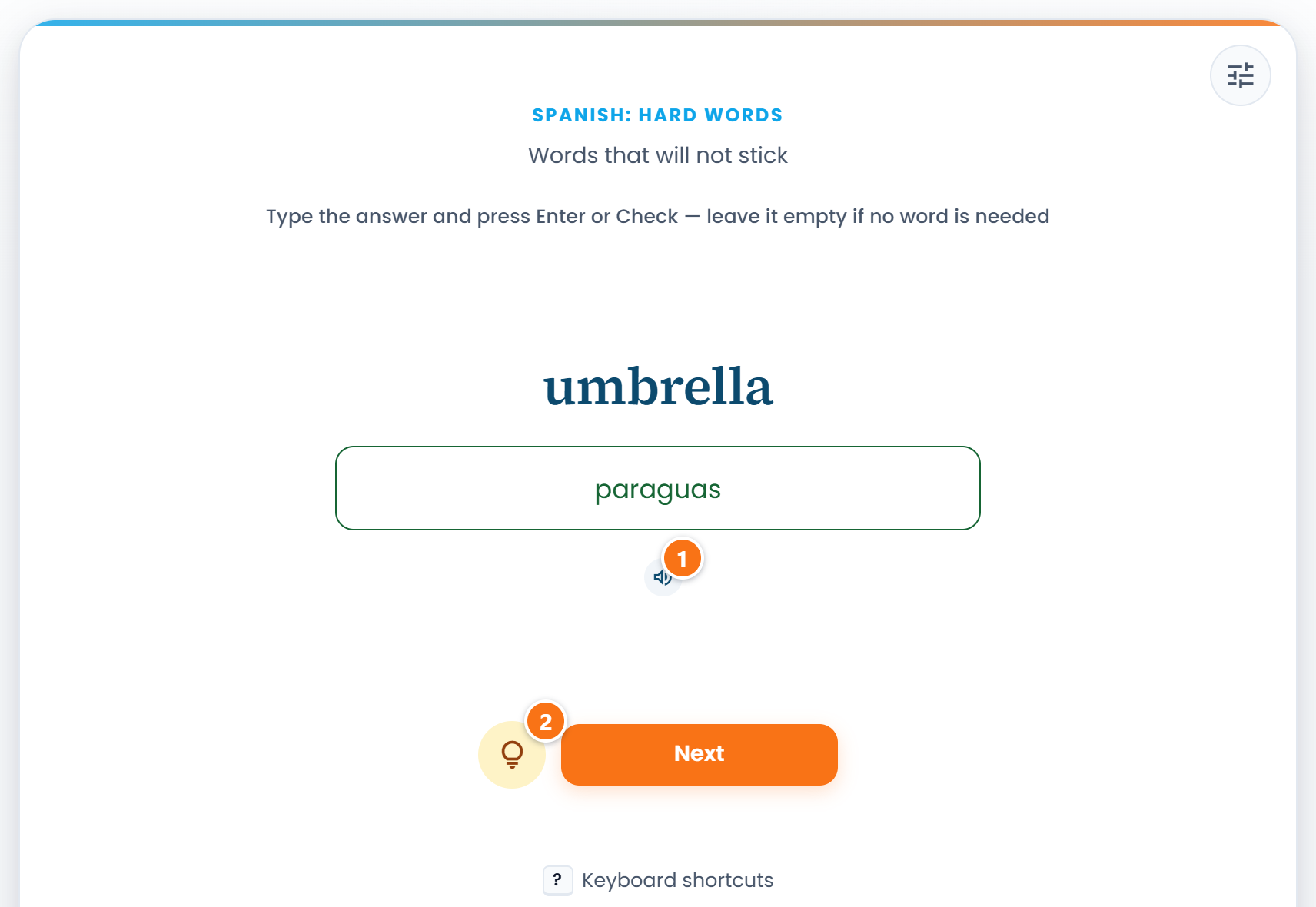 ① — pronunciation of the answer word; ② — the card's note, where your sentence lives.
Your own story: the "Explanation" field
On the deck page, open a card for editing: the form has an Explanation field, a note shown after the answer, behind the lightbulb, not together with the question, so it does not give the answer away. That is where your sentence goes: a story for one word, like one knyga in one sentence for the Dutch students.
Cards in someone else's deck cannot be edited, so for the words that won't stick, start your own: on the decks page press Create deck, and inside it Add card. The button's menu has Add with AI: paste a list of words, the cards are built for you, and all that is left is to add your sentence in Explanation. Usually that is a handful of words, not the whole deck.
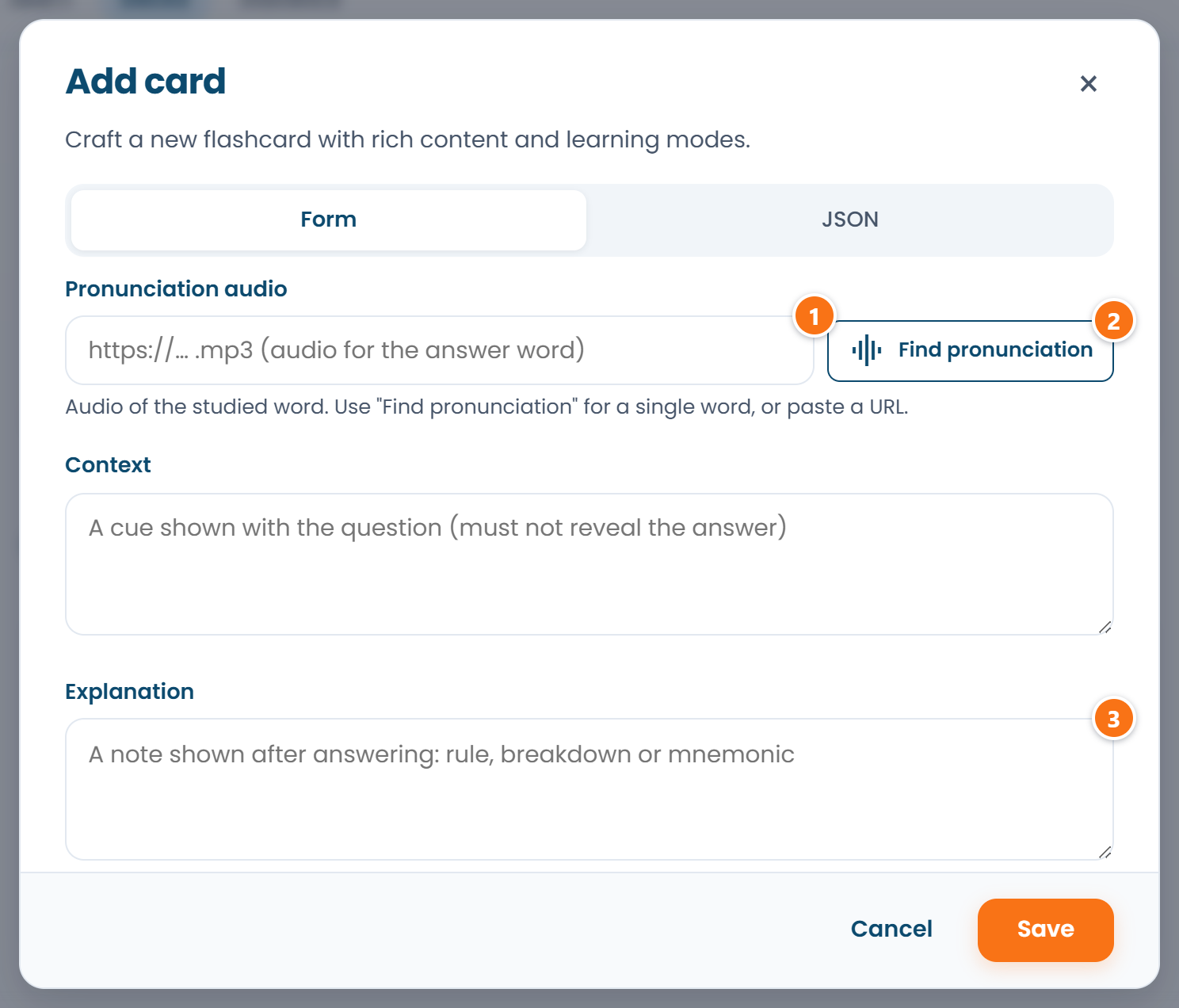 ① — the field with the link to a pronunciation recording; ② — Find pronunciation looks up an
open recording of the word; ③ — Explanation: your story for the word.
Your own sentence: Cloze Type mode
Turn your sentence into a task: in the same card's form, enable Cloze Type, paste the sentence into the Context sentence field and mark the word as the gap. Exactly how is in the guide on a card with a gap. Written once, it then tests itself: spaced repetition brings it back when the word starts to fade.
What the techniques won't do
- They won't replace the schedule. In Bower and Clark's experiment there was a single test, at the end of the same session, and admittedly that is all the study can tell us about staying power. Your own story is a strong hook for the first recall; for a word to hold for months, the hook has to fire again at growing intervals. How that works is in the article on spaced repetition.
- They won't get you to speech. In skill acquisition theory, which Robert DeKeyser systematised for languages, knowledge passes through three stages: declarative (I know the word's meaning as a fact), procedural (I can retrieve it if I stop and think) and automatic (it comes by itself, mid-sentence). A card works on the first two. The third comes only from use: in writing, in conversation, even in a chat with an AI. That is no longer about memorising but about practice.
Where to start today
Open any foreign-language deck and, on the first five words that came back with effort, say the answer aloud before Check, then compare with ▶. The two or three that have refused to stick for more than a week, move to a deck of your own and write a sentence of yours for each in the explanation. That takes ten minutes; from there the schedule does the work.
FAQ
Should I read everything aloud?
No, and that is the most unexpected result in the research on saying words aloud. The effect works as a contrast: a spoken word is remembered better because it stands out among the ones read silently. The group that read the whole list aloud remembered it no better than the group that read silently. Choose what to say: the hard words and the ones you have already failed.
Do I need a voice recorder?
Not for memory. According to Forrin and MacLeod, saying a word here and now is no worse than hearing yourself in a recording, and your own recording beats a stranger's voice. A recorder is for something else: hearing your pronunciation from the outside and comparing it with a native speaker's recording.
Why can't I write sentences with a new word right away?
Because in the first encounters with a word, attention goes to the meaning of the sentence rather than the form of the word: in Barcroft's study, students who wrote sentences with new words reproduced the words themselves worse. Fix the spelling and the sound first, then use it.
How many words a day can I learn?
The limit is not the first encounter but the returns: every new word then has to be repeated several times at growing intervals, and ten new words a day become, a month later, a daily queue of dozens of reviews. That is why RepeatMe introduces at most 20 new cards a day by default; the threshold can be changed in your profile.
How many times do I have to repeat a word to remember it?
What matters is not the count but the distance between repetitions. The same number of repetitions spread over growing intervals — a day, a few days, weeks — holds a word longer than the same number in one evening. How the moment of return is chosen is in the article on spaced repetition.
Does this work for grammar?
Saying it aloud and your own sentence work for rules too, with the same caveat: understand the rule first, then reinforce it. For a rule with variants (verb forms, articles) a card with a gap, where the sentence is new every time, is the better fit.