 RepeatMe
When a card comes back, and what your rating decides
A card does not come back on a timer: its next date is recalculated after every answer you give. You will need a deck you have already run through at least one session, or there is nothing to look at.
The first minutes: the card is still being learned
A new card starts in learning, and there the schedule is counted in minutes rather than days. Answer correctly and it returns in about ten minutes. Get it wrong and it returns in about a minute, with an easier question next time.
In a small deck you see this immediately: the same few cards come round every few shows. That is the intent. Until the knowledge comes back reliably, there is nothing worth postponing for days.
A card moves onto the calendar once you have given two correct answers in a row and rated Correct in two different hard modes. Hard modes are the ones where you have to produce the answer yourself: typing it and filling a gap in a sentence, in either direction. Flip, multiple choice and matching pairs are not hard modes. A Hard rating keeps the streak going but does not close a hard mode — the card comes round again to give you a clean shot at it.
If the card carries only one hard mode, that one is enough. If it has none at all — say only flip and multiple choice are switched on — it moves on once every one of its modes has been rated Correct. The first calendar interval is always one day.
Days and weeks: how the interval grows
The second interval is about six days, and each one after that is the current interval multiplied by the card's "ease". Ease starts at 2.5 and moves with your ratings: Correct lifts it by about 0.1, Hard drops it by 0.14. It never leaves the range 1.3 to 3.0.
That is where the spread inside one deck comes from. A card you consistently rate Correct is months out after a few reviews. One that is a struggle every time gains days far more slowly and keeps coming back every week or two for a long time — which is not a fault, it is exactly what you want the schedule to do.
The mode you answered in also counts. Only the hardest mode available on that card extends the date in full; an easy one (multiple choice, matching pairs) gives less — so a lucky guess does not carry a card as far as an answer produced from memory. The comparison is made inside the card: if typing and gaps are switched off on it, whatever mode is left becomes its hardest.
What you choose with the rating button
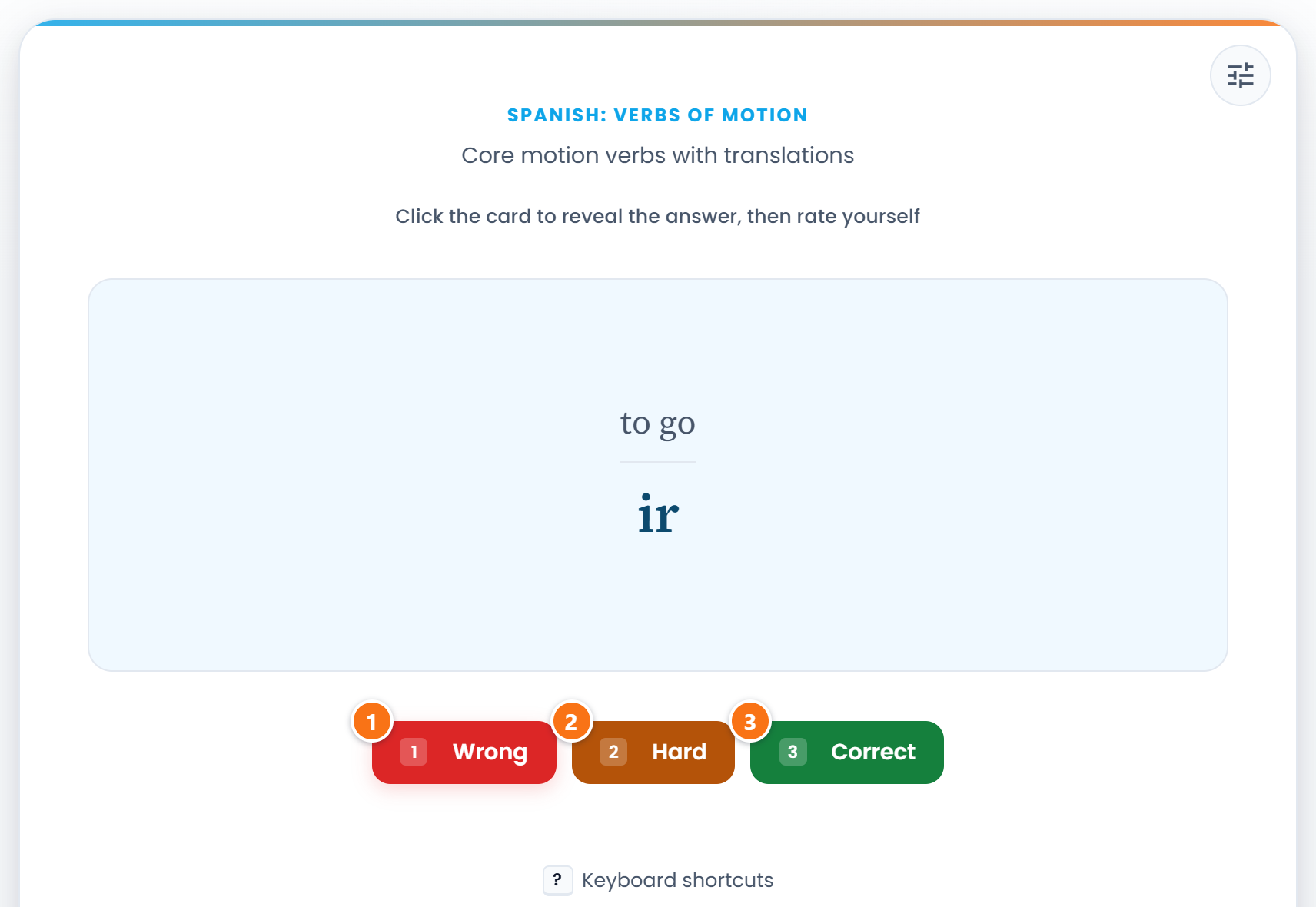 ① Wrong · ② Hard · ③ Correct — the three prices of one review.
In flip modes you set the rating yourself — Wrong, Hard or Correct. In graded modes the check sets it for you: an exact answer counts as Correct, an answer that is one or two characters off counts as Hard, anything else counts as Wrong.
| Rating | While the card is being learned | Once it is on the calendar |
|---|---|---|
| Wrong | back in a minute, next question is easier | goes to relearning, ease −0.2 |
| Hard | back in about ten minutes, hard mode stays open | interval grows less, ease −0.14 |
| Correct | back in about ten minutes, a step towards the calendar | full growth, ease +0.1 |
"Full growth" in the right-hand column is a ceiling rather than a promise: it goes to an answer given in the card's hardest mode, and no earlier than the due date. The two dampers are below.
The rating answers one question: did you recall it, or did you peek? A Hard on a card you genuinely dragged out of memory after a pause serves you better than a Correct given out of politeness to yourself.
A mistake does not reset the card
A wrong answer on a card that already lived on the calendar does not send it back to the start. The card goes to relearning: it returns in about ten minutes, and it needs two correct answers in a row to get back onto the calendar. The interval is kept — you return to the same date you had before the mistake, not to one day.
You do have to earn the calendar back, and ease drops by 0.2, so the interval grows more slowly from there. What is not reset is the interval itself. How often this has happened is the Lapses figure on the Statistics page.
Why an early review barely moves the date
When the cards due today run out, the session counter changes to "All required done · Early review" and you can keep going. But the growth of the interval is measured against how much of the planned wait you actually sat out. Answer a card on the same day you last saw it and the date barely shifts.
The same multiplier damps the gain in ease, so an evening of cramming cannot accelerate future dates by the back door: twenty correct answers in a row will not send a card half a year out. For the same reason Drill card — the mode that narrows the session to a single card — credits exactly one answer: the repetitions after it change neither the schedule nor today's progress.
Where to see what is happening to your memory
The Memory section on the Statistics page sorts your cards into four states:
- New — you have not started them;
- Learning — being learned or relearned, scheduled in minutes;
- Consolidating — on the calendar, but still on a short interval;
- Long-term — the interval has reached three weeks or more.
 All four cards of this deck are still Learning — their schedule is counted in minutes.
The share of that last state is also shown on the page as a figure of its own — Long-term. It moves slowly, and that is the point: it measures memory rather than how much you did today.
FAQ
Can I set the intervals myself?
No — dates come only from your answers. What you can change indirectly is the set of modes: turn off the ones you do not want under Learning Modes, and what counts as the hardest mode for a card changes with them.
What happens if I skip a week?
Nothing is lost. Overdue cards wait and come first, ahead of cards whose date has not arrived yet. The waiting multiplier stops at one: answering early cuts the gain, while extra weeks beyond the due date add nothing to it, so a late answer does not inflate the next interval.
Why does the same card arrive as a different question each time?
The schedule belongs to the card, but the form of the question is picked at each show, weighted towards the ones where you have to produce the answer. There is more on this in One card, nine questions.
Does "Drill card" count as a review?
One answer counts; the rest are practice and change neither the date nor your progress for the day. That is deliberate — answers given back to back say nothing about whether you will recall the card in two days.