 RepeatMe
Anki alternative: what changes when you switch to RepeatMe
In Russian: Альтернатива Anki: что меняется при переходе на RepeatMe
Anki works, and it keeps people for years. What sends them looking elsewhere is rarely the algorithm — it is everything standing in front of the algorithm: an interface from another decade and settings you have to understand before you can study. Learning steps, the ease modifier, FSRS or SM-2, an add-on for every task. You end up learning the program instead of the material.
Then the concrete reasons pile on. You need to hand a deck to your students, and they will not install Anki. The iPhone app is paid. The type-in mode compares your answer character by character, so a synonym looks like a mistake.
Below: what the switch gives you, what stays behind in Anki, and how to move a deck. The main thing about moving: your review history travels with the cards. Intervals, ease and due dates arrive as they are — what you had learned does not start over, and what was overdue arrives overdue.
Why people leave Anki
- Settings come before studying. Learning steps, interval modifiers, a choice of algorithm, add-ons. There are so many that "which values are the right ones" is still an open question years in.
- The queue grows faster than you clear it. A hundred new cards in a week become several hundred reviews a day, and one skipped holiday becomes a debt you are afraid to approach.
- Every card is made by hand. A good card with an example takes minutes, and the time goes into preparing rather than reviewing.
The switch settles all three. On the queue: new cards are released under a daily cap — 20 a day per account by default, same as Anki's default, and you can lower it to zero or raise it in your profile. The cap is one setting for every deck, not a preset per deck.
What stays the same
Both are built on spaced repetition: a card comes back shortly before you would forget it, and the better you know it, the less often it returns. Both are free in the main scenario: Anki on desktop and Android, RepeatMe in a browser on any device. Both survive a break: a skipped week does not reset the deck, it piles up an overdue queue.
What the switch gives you
- Nothing to configure. No learning steps, no modifiers, no choice of algorithm: the schedule works itself out and the only thing you decide is which modes you want. That has a flip side, and it is right below.
- A deck is a link you send. The other person opens the address and starts learning: no install,
no sign-up, no explanation of how to import an
.apkg. A guest's progress lives in their browser and moves into an account when they sign in there.
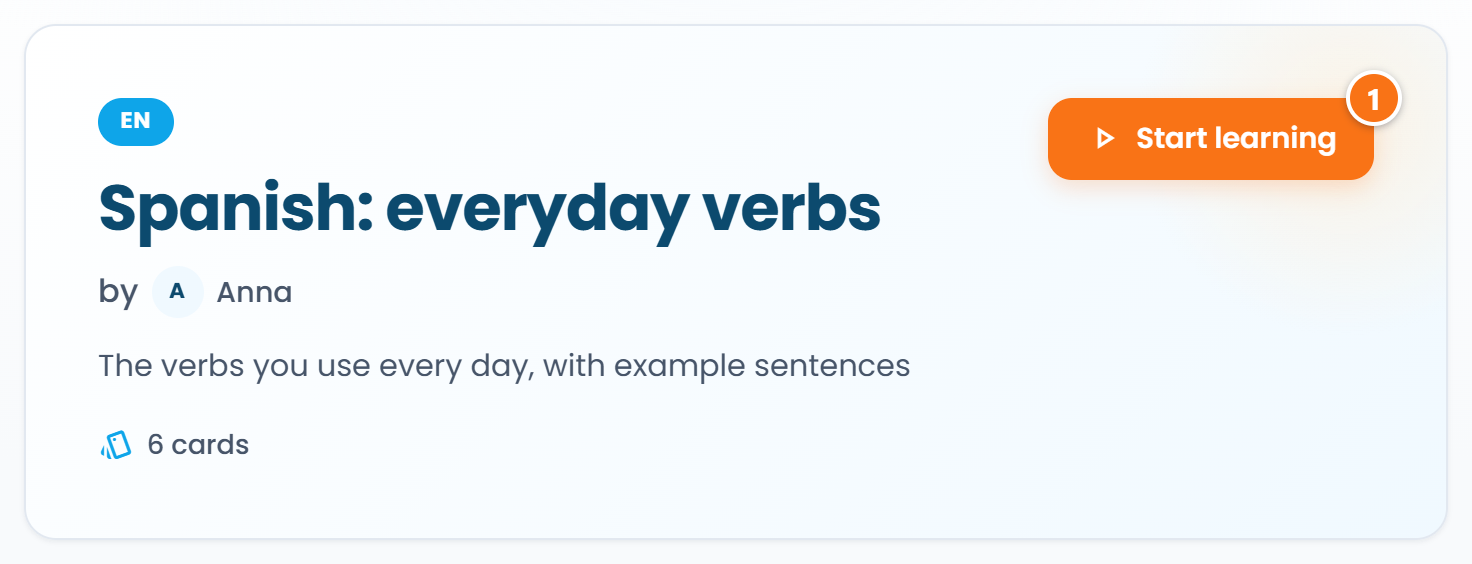 ① — the session starts from the link; no account needed.
- Nine questions from one card. In Anki a card is a template, and asking in the reverse direction means a second template. Here the modes are derived from the card's data: fill in the accepted answers and typing appears; add a sentence with a gap and the cloze mode appears. A typed answer is checked against a set of accepted ones, and a typo is not a failure. The modes are described in the help.
- One address on every device. Your computer and your phone open the same page — nothing to sync and nothing to install. The site adds itself to a home screen like an app and lets you review offline; the answers go up on the next connection.
- AI writes the cards. A deck is built from a description of the topic, and for existing cards the AI fills in accepted answers and gap sentences. A list of words becomes cards in the deck's own style. How to turn it on is explained in the help.
- Pronunciation, a lesson and feedback. For a language deck the service looks up a recording of the answer word itself. A deck can carry a lesson article, a learner can report a mistake in a card straight from the session, and the author sees which cards learners struggle with, if they allowed it.
What stays behind in Anki
- Scheduling controls. A preset per deck, learning steps, ease modifiers, FSRS. Here there is one account-wide control — a daily cap on new cards — and past that one SM-2 implementation of our own and not a single knob. If you need a cap per deck or FSRS, that is a reason to stay.
- A card as a page. Your own HTML and CSS, conditional fields, formulas, any layout. A RepeatMe card is text, pictures and sound, and its typography belongs to the site.
- Add-ons. On desktop, Anki has hundreds of them, from advanced statistics to text-to-speech. RepeatMe has only what is built in.
- Handling difficult cards. Suspend, bury until tomorrow, catch leeches automatically. Here a card can be edited or deleted.
- A program on your own disk. Anki runs with no network at all, which also means syncing between the computer and the phone is on you. Here it is the other way round: reviewing offline works, editing a deck does not.
What gets lost in the move
The .apkg import brings the content over, but not all of it:
- Tags and subdecks. A card here has no tags, and subdecks merge into one deck.
- Templates. Complex note types collapse to a plain question and answer pair.
- Some media. Files over 5 MB and anything past your storage quota stay in Anki; the post-import report says exactly how many did not make it.
Pictures, sound, cloze deletions, bold, italic, links and the review history all make it. The full list is in the import guide.
Where to start
Take the deck you are reviewing right now and move it whole — with its scheduling. The cards arrive in the state you left them in: the first session here continues yours instead of starting over. Nothing is deleted in Anki; the collection stays where it is.
A week on one deck is enough to decide about the rest — each move takes five minutes. There is a way back, too: any of your decks exports to CSV, and Anki reads text files.
FAQ
Does my Anki review history transfer?
Yes, if you export the deck with Include scheduling information ticked — Anki leaves it unticked by default. Interval, ease and the next due date come over as they are, with nothing smoothed away. A two-way note becomes one card with two modes and travels on its weaker side; if you never studied one direction, the card arrives new.
Does RepeatMe have FSRS?
No. Scheduling is our own SM-2 implementation, with no settings. What affects the interval is not only your rating but also the mode you answered in: producing a word from memory earns more than recognising it among options.
Is there a mobile app?
It is a web app that installs on a phone from the browser: an icon on the home screen and offline reviewing. There are no separate store apps.
Can I go back to Anki later?
Yes. Any of your decks exports to CSV from the deck page, and Anki imports such a file as text. The CSV carries the question and the answer; modes, pictures and sound stay here.